
Operations
The Hidden Cost of Kiosk Downtime: Why Enterprise Operators Need Proactive Fleet Monitoring
8 mins read
Operations
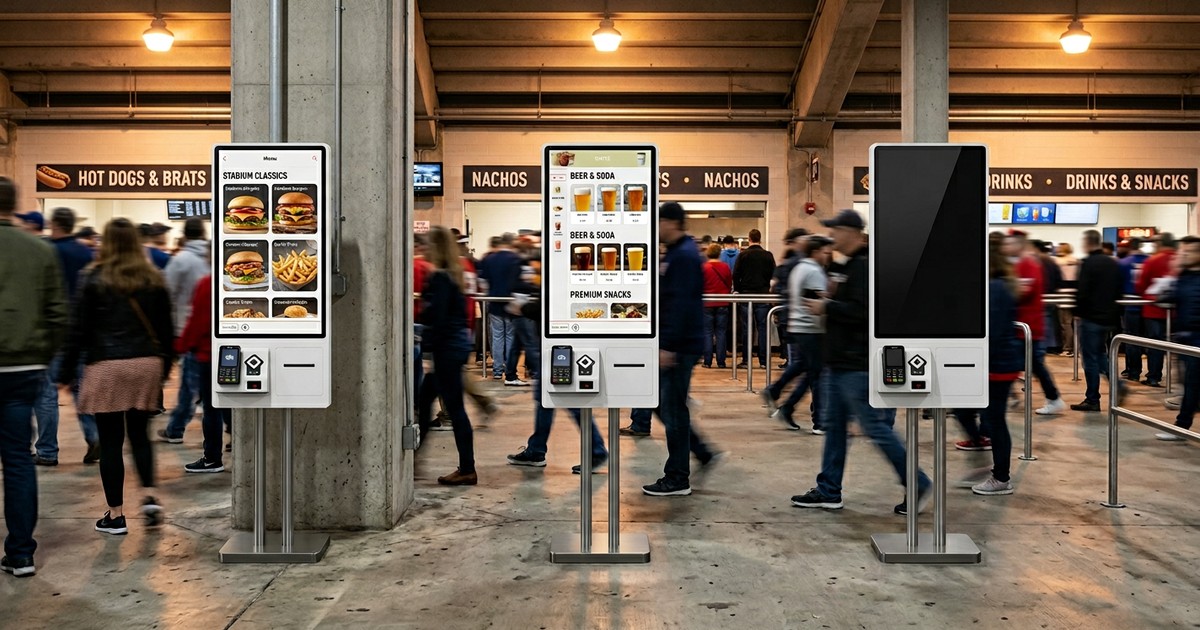
It's halftime at a 40,000-seat stadium. Fifteen thousand fans hit the concourses with twelve minutes on the clock. Three of your twenty self-service kiosks are offline — one frozen on a payment screen, one showing a configuration error, and one simply black. No alert was sent. No one noticed until the lines started growing.
By the time a runner tracks down the ops manager, six minutes have passed. The remaining kiosks are slammed. Guests abandon lines. Per-cap spend drops. And the problem repeats at the next event because no one captured what went wrong.
This isn't a hypothetical. It's a Tuesday.
Most operators think about kiosk downtime in terms of the single transaction they missed. The actual cost is compounding.
Industry benchmarks from the National Restaurant Association and QSR operational studies show that a single self-service kiosk in a high-traffic environment can process $800–$1,500 in orders per hour during peak periods. When a kiosk goes down, that revenue doesn't redistribute evenly — studies consistently show that 20–30% of guests who encounter an out-of-service kiosk abandon their purchase entirely rather than joining a staffed line.
For an operator running 50 kiosks across five venues, even a modest 2% daily downtime rate — roughly 12 minutes per kiosk per day — adds up:
And that's just the direct transaction loss.
Revenue loss is the number everyone fixates on, but it's the smallest line item in the true cost of unmanaged downtime.
When kiosks fail, staff get pulled from prep, fulfillment, or guest service to manually take orders. A 2024 workforce study from the Bureau of Labor Statistics reported that the average fully-loaded cost of a quick-service restaurant employee is $18–$22 per hour including benefits and overhead. Every kiosk failure triggers an unplanned labor shift — and in high-volume environments, that means pulling from kitchen production, slowing fulfillment for all channels.
Guests don't distinguish between "the kiosk is broken" and "this brand doesn't have it together." A 2024 Deloitte study on digital experience in foodservice found that 73% of consumers say technology reliability directly influences their perception of a restaurant brand. A dark kiosk screen in a premium venue — a stadium club level, an airport lounge, a casino resort — sends a signal that undermines every dollar spent on brand experience.
Without proactive monitoring, every fix is an emergency. Emergency dispatches, after-hours vendor calls, and expedited hardware replacements cost 2–3x more than scheduled maintenance. A reactive-only approach also means operators are replacing hardware on failure rather than managing lifecycle proactively — leading to premature fleet-wide refreshes that blow capital budgets.
A kiosk that reboots and comes back with a stale menu, wrong pricing, or a missing LTO isn't "back online" in any meaningful sense. It's creating a guest experience that's worse than being offline — because now you're actively serving incorrect information. Without centralized configuration management, every recovery is a roll of the dice.
Most operators have some monitoring. A tablet dashboard in the back office. An email alert when a device drops off the network. Maybe a shared spreadsheet where managers log issues.
At five locations, this is manageable. At fifty, it's a liability.
Traditional monitoring tells you a device is online or offline. It doesn't tell you:
Binary up/down monitoring misses the operational health signals that predict failures before they happen.
Enterprise kiosk deployments generate enormous volumes of log data. Payment gateway responses, POS integration handshakes, peripheral status checks, application-level events — the data exists. But without intelligent aggregation and alerting, it sits in silos. The information that could have predicted this morning's failure is buried in last night's logs that no one reviewed.
In multi-location operations, kiosks are configured at deployment and then managed reactively. Over time, firmware versions diverge. Payment terminal configurations fall out of sync. Menu databases update inconsistently. This drift is invisible until it causes a failure — and then the troubleshooting process is exponentially harder because no two kiosks in the fleet are running the same stack.
Proactive monitoring isn't just better alerting. It's a fundamentally different operating model — one that treats kiosks as a managed fleet rather than individual appliances.
Not just device status — transactional health. Is each kiosk completing orders end-to-end? What's the average order completion time? Which locations are showing degraded performance before they hit failure? Fleet-level visibility lets operators spot patterns — a venue where kiosks consistently slow down at 6 PM (network congestion), a hardware batch with higher-than-normal reboot rates (firmware issue), a location where payment declines spike on weekends (terminal configuration).
The most impactful monitoring systems don't just detect problems — they resolve them. Automated recovery workflows can restart frozen applications, re-initialize payment terminals, and resync menu configurations without human intervention. For common failure modes, the kiosk is back in service before a guest ever sees a dark screen.
Centralized, over-the-air configuration management ensures every kiosk in the fleet is running the correct menu, pricing, branding, and payment configuration — and can be updated in minutes, not days. When an LTO launches Tuesday morning, every kiosk across every location reflects it by open. When a payment processor pushes a gateway update, terminal configurations are synchronized fleet-wide.
Reboot frequency trending up. Payment decline rates climbing. Order completion times degrading. These are the leading indicators that a kiosk is heading toward failure — and they're only visible with continuous telemetry and historical trending. Proactive operators use this data to schedule maintenance during off-peak hours, replace hardware before it fails in service, and identify systemic issues before they affect the fleet.
Enterprise operators need a single pane of glass across all venues, all kiosks, all configurations. Not a different dashboard per location. Not a VPN tunnel to each site. One platform where the technology team can see fleet health, push changes, and respond to issues — whether they're managing 50 kiosks or 500.
The business case for proactive fleet monitoring isn't theoretical. Here's what operators should model:
| Cost Category | Reactive Approach | Proactive Approach |
|---|---|---|
| Lost revenue per kiosk-hour of downtime | $800–$1,500 | Near-zero (sub-60-second recovery) |
| Emergency maintenance dispatches/year | 40–60 per 50 kiosks | 5–10 (scheduled) |
| Labor hours reallocated to manual ordering | 200+ hours/year | Minimal |
| Guest complaints tied to kiosk issues | Frequent, unquantified | Rare, tracked |
| Fleet hardware lifecycle | Reactive replacement | Managed, predictable |
For a 50-kiosk operation, the shift from reactive to proactive fleet management typically represents $100,000–$250,000 in annual recovered revenue and avoided costs — before accounting for the guest experience and brand perception improvements that don't show up in a spreadsheet.
If you're operating more than 10 self-service kiosks, here's a practical framework:
Audit your current visibility. Can you answer, right now, how many of your kiosks are processing orders successfully? If not, that's your starting point.
Define "healthy" beyond online/offline. Establish KPIs: order completion rate, average transaction time, payment success rate, configuration currency. Monitor against thresholds, not just binary status.
Centralize configuration management. Eliminate the scenario where recovering a kiosk means sending someone on-site to manually reconfigure it. Over-the-air management is table stakes for enterprise operations.
Instrument for prediction, not just detection. Capture the telemetry that lets you see failures coming — reboot trends, performance degradation, peripheral health — and build workflows that act on those signals.
Quantify your downtime cost. Use the math above to build a business case that's specific to your operation. When the CFO asks why fleet monitoring is in the budget, the answer should be a number, not a narrative.
Every dark kiosk screen is a line item you'll never recover. The operators who are winning in high-volume foodservice aren't the ones with the fanciest kiosks — they're the ones who know, in real time, that every kiosk is working, every menu is current, and every guest is being served.
XPRPOS Fleet Manager gives enterprise operators centralized visibility and control across their entire kiosk deployment — real-time health monitoring, remote configuration management, and the operational intelligence to keep every screen earning.
Ready when you are
Book a 30-minute demo. We’ll set it up with your menu, your brand colors, and the full ordering-to-kitchen flow on your POS — not a generic walkthrough.