
Blog
Why Enterprise QSRs Are Going All-In on Self-Service Kiosks: The 2026 ROI Case
6 mins read
Blog
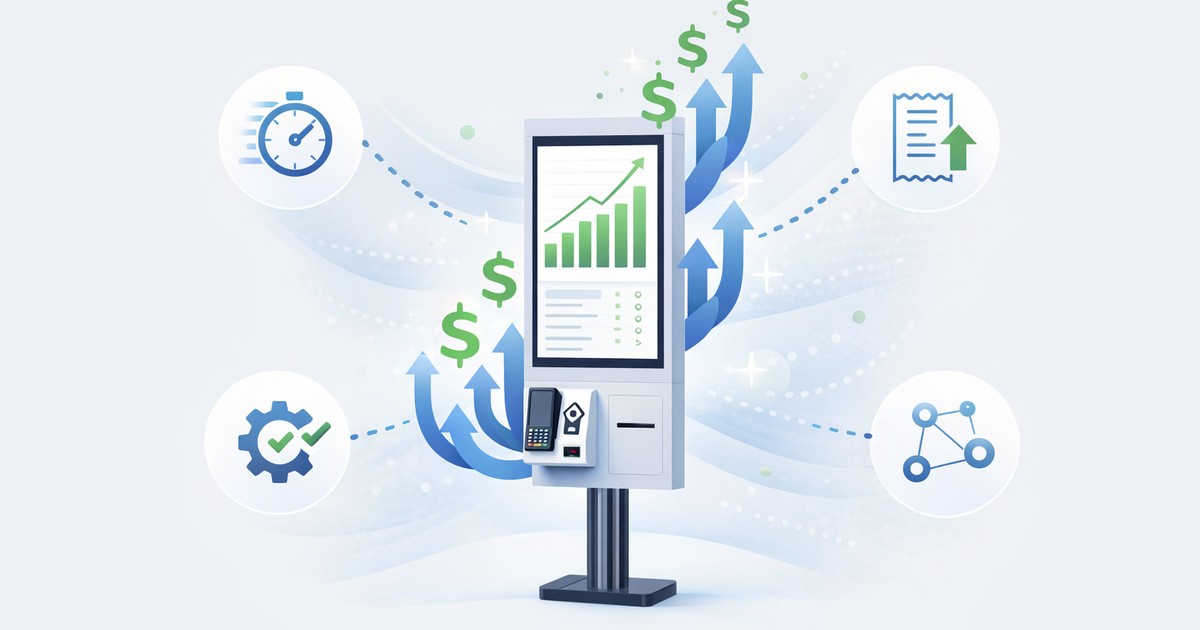
The conversation has shifted. Enterprise QSR leaders are no longer asking whether to deploy self-service kiosks — they're asking how fast they can roll them out across every location. What changed? The ROI data from early adopters is now undeniable, and the operational math has fundamentally tilted in favor of kiosk-first service models.
Here's why 2026 is the year enterprise QSRs are treating self-service kiosks as critical infrastructure, not optional upgrades.
The business case for self-service kiosks has matured beyond pilot-stage optimism into enterprise-grade certainty:
For a 500-location enterprise chain, these improvements compound into tens of millions in annual impact. That's not a technology experiment — it's a strategic imperative.
Several converging factors are making 2026 the year of mass kiosk adoption:
Minimum wage increases across major markets have pushed hourly rates above $17 in most urban areas. The cost-per-transaction math now clearly favors kiosk-assisted ordering for the majority of standard menu transactions.
Post-pandemic ordering habits have permanently changed. Over 70% of QSR customers under 45 now prefer self-service options when available. The kiosk isn't replacing hospitality — it's meeting customers where they already want to be.
Enterprise-grade kiosk hardware costs have dropped 25–35% since 2023, driven by supply chain normalization and increased manufacturer competition. The payback period for a single kiosk unit has compressed to under 8 months in high-traffic locations.
Modern kiosk platforms now offer seamless integration with loyalty programs, dynamic menu pricing, allergen filtering, and real-time inventory management — capabilities that were custom-development projects just two years ago.
Large QSR chains have a structural advantage in kiosk deployment that's accelerating the gap between enterprise and independent operators:
Centralized Menu Management — Update pricing, promotions, and seasonal items across hundreds of kiosks simultaneously, ensuring brand consistency without per-location manual intervention.
Data-Driven Optimization — Enterprise-scale ordering data enables AI-powered menu personalization, daypart-specific layouts, and predictive upselling that improves with every transaction across the entire network.
Negotiating Power — Volume hardware procurement, standardized installation processes, and dedicated support contracts reduce per-unit deployment costs by 15–25% compared to smaller operators.
Omnichannel Integration — Kiosks become one node in a unified ordering ecosystem alongside mobile apps, drive-thru, and third-party delivery — all sharing a single source of truth for menus, pricing, and customer data.
Here is a simplified model for a single location deploying two kiosks:
At $5,500 in net monthly benefit per location, the payback period on initial hardware investment falls between 3–8 months depending on traffic volume and average check size. For a 200-location chain, that translates to over $13 million in annualized net benefit — a figure that gets the attention of every CFO and board member.
The key variables to model for your specific operation: average daily transaction count, current labor cost per transaction, historical average check size, and your target kiosk adoption rate (typically 35–60% of in-store orders within six months of deployment).
The ROI case extends beyond direct revenue and cost metrics:
The most successful enterprise deployments aren't eliminating positions — they're elevating them. Front-counter staff move into expeditor, hospitality, and quality assurance roles that directly improve customer satisfaction scores.
Kiosks don't take breaks, don't slow down during rushes, and can process orders simultaneously. During the lunch rush — where every minute of throughput matters — kiosks consistently outperform traditional counter ordering.
New employee onboarding for counter ordering typically requires 8–16 hours of POS training. Kiosk-first models reduce this requirement significantly, allowing faster ramp-up during seasonal hiring cycles.
Every kiosk transaction generates clean, structured data — no handwriting interpretation, no verbal miscommunication, no modifier ambiguity. This data quality improvement cascades into better inventory forecasting, waste reduction, and supply chain planning.
Despite the clear ROI, some enterprise operators are still hesitant. The common concerns:
Forward-thinking enterprise QSR leaders are viewing kiosks not as point-of-sale terminals, but as customer experience platforms. The kiosk screen is becoming:
This platform thinking is what separates incremental kiosk deployments from transformative ones.
The 2026 ROI case for enterprise QSR self-service kiosks isn't theoretical — it's proven, it's compounding, and it's widening the competitive gap between early movers and those still deliberating. The chains that deploy aggressively this year won't just see better margins — they'll build operational capabilities and customer data advantages that compound over time.
The question for enterprise QSR leaders isn't whether kiosks make financial sense. It's whether you can afford to let another year pass while your competitors capture these gains.
XPR POS provides enterprise-grade self-service kiosk solutions purpose-built for multi-location QSR operations. Learn how our platform delivers measurable ROI at scale.
Ready when you are
Book a 30-minute demo. We’ll set it up with your menu, your brand colors, and the full ordering-to-kitchen flow on your POS — not a generic walkthrough.