
Compliance
ADA Compliance for Self-Order Kiosks: The Liability Gap Most Multi-Unit Operators Are Ignoring
9 min read read
Compliance
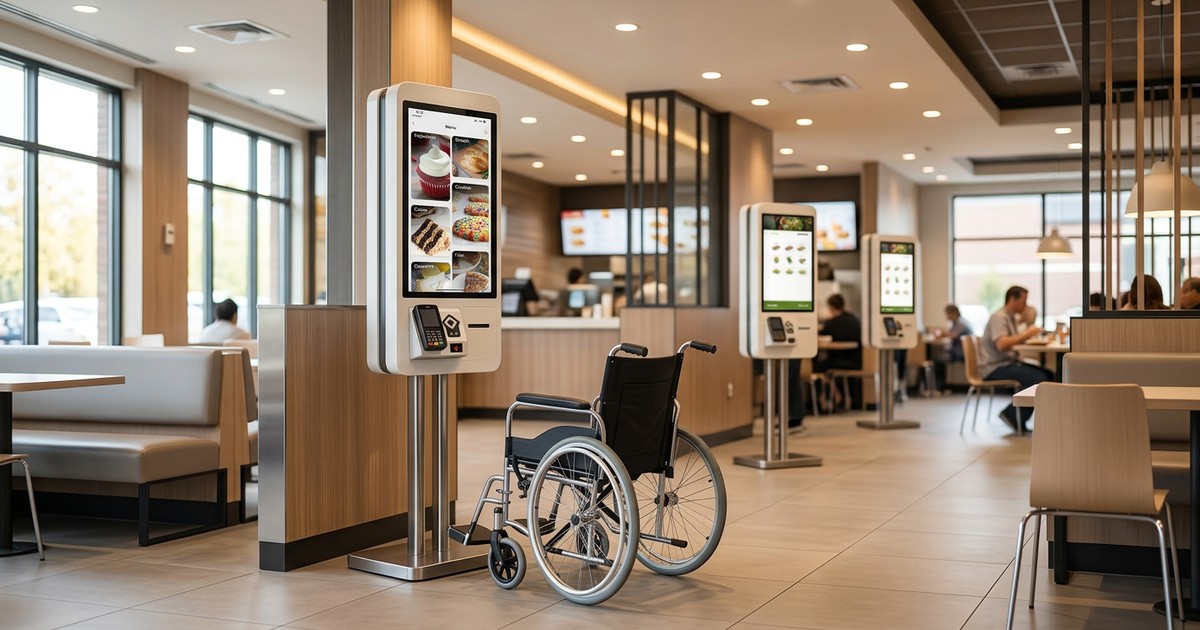
The self-service kiosk rollout across quick-service restaurants, fast-casual chains, stadiums, airports, and casinos has been extraordinary. The global installed base now sits between 8 million and 15 million units, with restaurant self-ordering kiosks growing at 15 to 20 percent annually — outpacing nearly every other segment. QSR operators report average order value lifts of 15 to 30 percent and ordering time reductions of 20 to 40 percent.
But there is a problem hiding in plain sight. While kiosk deployments accelerate, accessibility compliance is not keeping pace. The result is a widening liability gap that exposes multi-unit operators to class action lawsuits, six-figure settlements, regulatory enforcement, and lasting brand damage. If you oversee technology or operations for a restaurant chain or enterprise venue, this gap demands your attention now — before a plaintiff's attorney brings it to your attention for you.
Many operators assume that because the federal government has not finalized kiosk-specific ADA standards, they are in the clear. That assumption is dangerous.
The Americans with Disabilities Act does not need a kiosk-specific regulation to apply. Title III of the ADA requires that places of public accommodation provide equal access to goods and services for individuals with disabilities. Courts have consistently interpreted this to cover self-service technology, including ordering kiosks.
Existing ADA and ABA Accessibility Standards already address self-service transaction machines such as ATMs and fare vending machines. These standards establish requirements for clear floor space, reach ranges, operable parts, speech output, Braille, and display screens — and courts look to them when evaluating kiosk accessibility.
In September 2022, the U.S. Access Board issued an advance notice of proposed rulemaking (ANPRM) on supplemental accessibility guidelines for self-service transaction machines, including self-order kiosks. By May 2024, the Board sent a proposed rule to the Office of Information and Regulatory Affairs. Although that particular proposed rule was withdrawn in January 2025, the rulemaking effort signals where enforcement is heading. Operators who wait for a final rule before acting are choosing to be reactive at the worst possible moment.
The Department of Justice retains full authority to enforce the ADA against businesses deploying inaccessible kiosks. The DOJ can initiate investigations, file lawsuits, and seek civil penalties. Its April 2024 final rule on web content and mobile app accessibility — mandating WCAG 2.1 Level AA compliance for state and local government digital services — further demonstrates the direction of federal enforcement priorities around digital accessibility.
Kiosk ADA compliance is not a single checkbox. It spans hardware design, software interface, installation, and operational procedures.
If the technical requirements feel abstract, the financial exposure should make them concrete.
ADA Title III lawsuits in federal court hit 3,117 filings in 2025 — a 27 percent increase over 2024 and the highest annual total since 2022. Since 2019, the industry has paid an estimated $370 million in settlements and damages across ADA accessibility cases. Self-service kiosks are an increasingly targeted category within this litigation wave.
The Ninth Circuit's 2024 ruling in a case involving LabCorp's self-service check-in kiosks is a landmark for the industry. The court certified both a nationwide injunctive relief class under the ADA and a California damages class under the Unruh Civil Rights Act. The blind plaintiff argued he was denied equal access because the kiosks could not be used without sight, forcing him to wait for employee assistance while sighted customers checked in independently. The case proceeded to trial, with the plaintiff submitting a fee petition exceeding $10 million. This is not a hypothetical risk — it is established precedent that applies directly to self-order kiosks in restaurants and venues.
The ADA permits "tester" plaintiffs — individuals who visit businesses specifically to identify accessibility violations and file suit. ADA Title III lawsuits have more than doubled over the past five years to exceed 10,000 per year, with nearly half filed in California, New York, and Florida. Plaintiffs' firms with class action capabilities are actively looking for the next target category, and the rapid proliferation of self-order kiosks across QSR and enterprise venues presents a large, visible attack surface.
Federal ADA compliance is the floor, not the ceiling. Several states impose requirements that significantly increase financial risk.
The Unruh Act applies to "all business establishments of every kind whatsoever" — broader than ADA Title III's scope. Critically, an ADA violation automatically constitutes an Unruh violation under California law. The financial consequence: $4,000 in statutory damages per violation, per visit, plus attorney fees. In a class action involving hundreds or thousands of locations and visits, the arithmetic becomes severe. In 2024, one California accessibility class action settled for more than $6 million in damages and fees.
New York state and city human rights laws prohibit disability discrimination in places of public accommodation with enforcement mechanisms independent of the federal ADA. Illinois's Information Technology Accessibility Act (IITAA) requires digital kiosks to meet WCAG Level A/AA standards for state agencies, and the state's Human Rights Act extends public accommodation protections broadly. Operators with multi-state footprints face a patchwork of overlapping obligations.
For a chain operating 500 locations across California, New York, Texas, and Florida, a single accessibility deficiency in the kiosk fleet can generate exposure across multiple federal and state claims simultaneously. The settlements in this space regularly exceed six figures, and class certification — as the LabCorp case demonstrates — is achievable.
Whether you are deploying new kiosks or evaluating an existing fleet, use this checklist to identify gaps before a plaintiff does.
Addressing kiosk ADA compliance is not purely a hardware problem or a software problem — it requires both to work together within a deployment strategy that accounts for physical space, interface design, and operational procedures.
XPRPOS is designed with accessibility in mind. The platform supports configurable timeout settings, high-contrast interface options, and compatibility with ADA-compliant hardware enclosures that meet reach range and clear floor space requirements. Rather than treating accessibility as an afterthought bolted onto an existing system, XPRPOS approaches it as a foundational element of the self-order experience — because operators should not have to choose between throughput and compliance.
For multi-unit operators managing fleets across states with varying regulatory requirements, having a technology platform that supports accessibility at the software level while integrating with compliant hardware reduces the burden of managing compliance location by location.
The pattern in ADA compliance is consistent: the cost of proactive compliance is a fraction of the cost of reactive settlement. The kiosk accessibility enforcement wave is not coming — it is here. The LabCorp precedent is established. Serial litigation firms are active. State laws are amplifying federal exposure. And your kiosk fleet is either compliant or it is a liability.
If you are a VP of Technology or Director of F&B Operations responsible for a multi-unit kiosk deployment, the next step is clear: audit your current fleet against the checklist above, identify gaps in hardware and software, and engage a technology partner that treats accessibility as a core platform capability rather than an optional add-on.
Request a consultation with the XPRPOS team to evaluate your kiosk fleet's compliance posture and explore how a purpose-built platform can help you close the accessibility gap before it becomes a legal one. Contact XPRPOS
Ready when you are
Book a 30-minute demo. We’ll set it up with your menu, your brand colors, and the full ordering-to-kitchen flow on your POS — not a generic walkthrough.