
AI & Automation
How AI Voice Ordering at the Kiosk Changes the Speed-of-Service Equation for Enterprise QSRs
7 min read
AI & Automation
The average drive-thru transaction in the United States took 6 minutes and 22 seconds in late 2025. For enterprise QSR operators managing hundreds or thousands of locations, every second in that window carries a measurable cost: lost throughput, abandoned orders, labor inefficiency, and guest dissatisfaction that compounds across the system.
AI-enabled chains are now pushing below 3 minutes per transaction. That gap — more than three minutes — represents the competitive distance between operators who are deploying AI voice ordering at scale and those still evaluating it from the sidelines.
The kiosk, already a proven tool for self-service ordering, is the next surface where voice AI will reshape the speed-of-service equation. Understanding what the technology actually delivers today, where it falls short, and how to evaluate vendors is now a strategic imperative for VP-level technology and operations leaders.
Traditional self-ordering kiosks changed the interaction model by shifting order entry from the counter to the guest. That delivered measurable gains in average check size, labor redeployment, and order accuracy. But touch-only kiosks still require guests to navigate menus visually, scroll through categories, and tap through modifier screens — a process that takes time and creates friction for guests unfamiliar with the menu or uncomfortable with touchscreen interfaces.
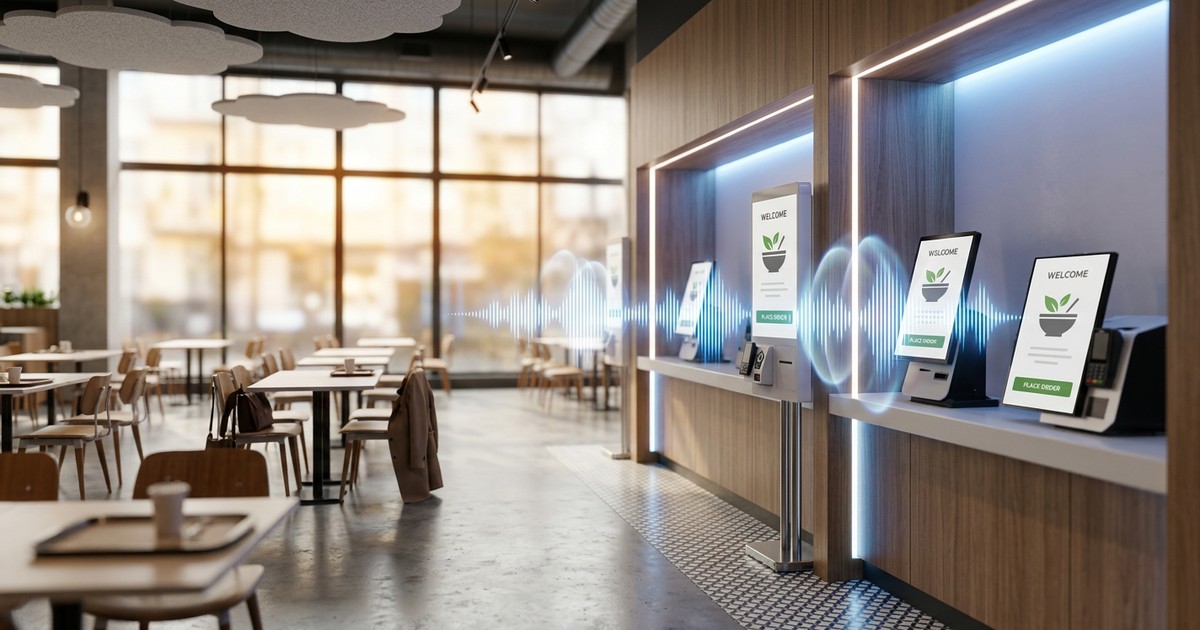
Voice changes the interaction model fundamentally. Instead of navigating a menu hierarchy, the guest states what they want in natural language: "I'll have a number three combo with no onions and a large Dr. Pepper." The system parses that request, maps it to menu items and modifiers, confirms the order, and sends it to the POS and kitchen display system.
This shift reduces the cognitive load on the guest and compresses the ordering time. For enterprise operators, it also opens new throughput possibilities: voice-enabled kiosks can process orders from guests who might otherwise wait in a staffed line, and they can handle upsell prompts conversationally rather than through static on-screen suggestions.
The convergence of natural language processing maturity, edge computing power, and noise-cancellation hardware — such as the beam-forming microphone arrays featured in devices like the URway AI Connect Bar — has made voice-enabled kiosks commercially viable for high-volume QSR environments in ways that were not realistic even two years ago.
The industry is no longer debating whether AI voice ordering works. The question is how well it works, at what scale, and under what conditions. Several major deployments provide concrete reference points.
Wendy's FreshAI, developed in partnership with Google Cloud, has expanded to more than 500 locations, making it one of the largest AI voice ordering deployments in the industry. The results reported by Wendy's include a 22-second reduction in average order time compared to human-staffed drive-thrus, order accuracy of approximately 92 percent after iterative model training, and a 15 percent increase in upsell attachment rates. The upsell lift is notable because it demonstrates that conversational AI can drive incremental revenue, not just speed.
McDonald's journey illustrates the complexity of enterprise AI deployment. After ending its voice ordering partnership with IBM, McDonald's pivoted to Google Cloud and expanded AI voice ordering testing to more than 200 U.S. locations under the new partnership. The program, now operating under the ArchIQ platform powered by Google Gemini, reflects a strategic bet that the underlying model and integration architecture matter as much as the voice interface itself.
Taco Bell's deployment surfaces one of the most important data points in the industry: the gap between standard and customized order accuracy. Reports indicate approximately 93 percent accuracy on standard orders versus approximately 82 percent on heavily customized orders with multiple modifiers. For a brand built on customization — where guests routinely swap proteins, add sauces, and remove ingredients — that 11-point gap represents a real operational risk. This modifier gap is not unique to Taco Bell; it is a structural challenge for any AI voice system operating against a complex, modifier-heavy menu.
White Castle's AI voice assistant Julia, built with SoundHound, has been deployed across the chain's drive-thru lanes with plans for broader rollout. The system processes orders in 60 seconds or less with accuracy rates reported above 90 percent. White Castle's willingness to commit to a scaled rollout signals confidence in the technology's operational readiness for smaller-footprint QSR environments.
At the 2026 National Restaurant Association Show in Chicago, the dominant theme among technology exhibitors was not AI novelty — it was integration depth. The Kiosk Association and The Industry Group anchored a dedicated Tech Hub focused on moving the conversation beyond standalone hardware toward integrated, infrastructure-level digitization.
Operator sentiment on the show floor reflected a clear priority: enterprise buyers are not looking for the most impressive AI demo. They are looking for a unified operating system that handles throughput, accessibility, and data processing simultaneously while integrating cleanly with existing POS, kitchen display, and payment infrastructure.
Vendors like SoundHound showcased their Dynamic Kiosk, a multimodal ordering experience combining voice, touch, and visual interaction. URway Holdings demonstrated the AI Connect Bar, a peripheral that adds conversational AI capability to existing kiosk and touchscreen hardware via a single USB-C connection. Both represent a market moving toward modular, integration-first voice AI rather than rip-and-replace solutions.
The strategic takeaway for enterprise operators is direct: the AI model powering the voice interface is only as valuable as its connection to the POS, KDS, loyalty, and payment systems that run the restaurant. A voice ordering system that cannot push a complex modified order into Oracle Simphony, PAR Brink, or Heartland POS with full modifier fidelity will create more problems than it solves.
AI voice ordering at the kiosk is a maturing technology, not a mature one. Enterprise operators evaluating deployment should account for several known challenges.
Modifier accuracy gaps. As Taco Bell's data illustrates, accuracy degrades on complex, multi-modifier orders. Any vendor claiming 95-plus percent accuracy should be asked to demonstrate that figure on the operator's actual menu, including the most heavily customized items.
Background noise and environmental interference. QSR dining rooms, drive-thru lanes, and food courts are noisy environments. Beam-forming microphone arrays and noise-rejection algorithms have improved significantly, but performance will vary by location acoustics.
Multilingual support. For enterprise operators in diverse markets, voice AI must handle multiple languages and accents reliably. McDonald's ArchIQ, for example, currently supports English and Spanish. Operators should evaluate language coverage against their specific market demographics.
Customer acceptance and adoption. Not all guests will choose to speak to a kiosk. A voice-enabled kiosk must also function as a fully capable touch-based ordering terminal. Voice should augment the kiosk experience, not replace the touch interface entirely.
POS integration trust. The most common concern from operators is whether voice-initiated orders will flow into the POS and KDS with the same fidelity as orders entered through traditional channels. This is not a theoretical concern — it is the primary reason deployments stall or fail.
For VP-level technology and operations leaders evaluating AI voice ordering kiosk solutions, the following six-point framework addresses the decisions that matter most.
POS integration depth. Does the voice ordering system integrate natively with your existing POS — Oracle Simphony, PAR Brink, Heartland, or others — at the modifier level? Superficial integration that drops modifiers or creates ghost tickets is unacceptable at scale.
Menu sync and CMS control. Can menu changes made in your POS or content management system propagate to the voice AI automatically, or does every menu update require manual retraining of the model?
Payment processor compatibility. Does the solution work with your existing payment stack — FreedomPay, Adyen, Datacap, or others — without requiring a separate payment flow?
Accuracy on your menu, not a demo menu. Request pilot data on your actual menu, including your highest-complexity items. Generic accuracy claims are insufficient for enterprise deployment decisions.
Fallback and escalation paths. What happens when the AI cannot resolve an order? Is there a clean handoff to touch-based ordering or staff intervention without restarting the transaction?
Hardware flexibility. Can the voice AI capability be added to your existing kiosk fleet, or does it require entirely new hardware? Modular solutions that extend existing investments reduce deployment cost and timeline.
XPRPOS is built on the principle that voice AI for kiosks must work within the operator's existing technology ecosystem, not around it.
XPRPOS kiosks integrate natively with Oracle Simphony, PAR Brink POS, and Heartland Genius POS, with full modifier-level fidelity. Orders initiated by voice flow into the POS and KDS through the same pathways as touch-based kiosk orders, ensuring operational consistency across all ordering channels.
On the payments side, XPRPOS supports FreedomPay, Adyen, and Datacap, allowing operators to maintain their existing payment processor relationships without adding a parallel payment flow for voice-initiated transactions.
Menu management is handled through cloud-based CMS sync, so menu updates, pricing changes, and limited-time offers propagate to voice-enabled kiosks without manual AI model retraining. This is a critical capability for enterprise operators running promotions across hundreds of locations on tight timelines.
"The winners in 2026 will not be the companies with the loudest AI messaging. They will be the vendors that reduce friction, integrate cleanly with existing POS and payment ecosystems, improve labor efficiency, and still function reliably five years from now."
That perspective guides every product decision at XPRPOS. Voice AI is a powerful capability, but it delivers enterprise value only when it is anchored to deep, reliable integration with the systems that actually run the restaurant.
If your team is evaluating AI voice ordering for kiosks, XPRPOS can demonstrate the technology running against your POS, your menu, and your payment stack. No generic demos. No slide decks. A working system configured for your environment.
Request a demo of XPRPOS AI voice ordering and see how integration-first voice AI performs on the menu items and modifiers that matter to your operation.
Ready when you are
Book a 30-minute demo. We’ll set it up with your menu, your brand colors, and the full ordering-to-kitchen flow on your POS — not a generic walkthrough.