
Self-Service Kiosks
How Airport Concessionaires Are Using Self-Order Kiosks to Serve More Passengers with Fewer Staff
7 min read
Self-Service Kiosks
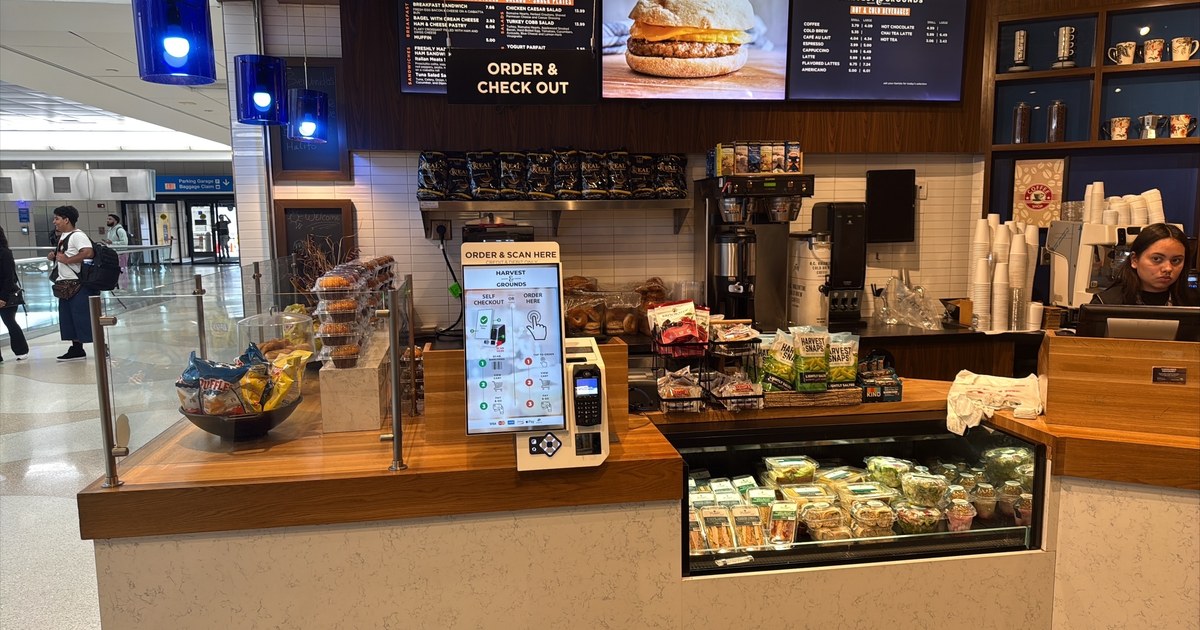
The numbers tell a stark story. During the 2025 holiday season, TSA projected screening of 44.3 million travelers through airport checkpoints in just over two weeks. That is a record-breaking volume that put enormous pressure on every concourse restaurant, grab-and-go counter, and coffee kiosk in the nation's busiest terminals. Meanwhile, the labor pool serving those passengers continues to tighten. Bureau of Labor Statistics data shows that leisure and hospitality wages have climbed 20 to 30 percent since 2019, and airport-specific wage mandates push costs even higher. The result is a widening gap between passenger demand and the workforce available to meet it.
For enterprise airport concessionaires, self-order kiosks have moved from a forward-looking experiment to an operational necessity. Here is how the economics, technology, and market trajectory are converging around the airport concession kiosk.
Airport workers do not earn standard quick-service wages. City living-wage ordinances establish mandatory minimums that far exceed national averages. As of mid-2026, LAX-area airport employers face a minimum of $25.96 per hour under the Los Angeles living-wage ordinance (with health benefit add-ons pushing total compensation above $32 per hour). SFO's Quality Standards Program sets a floor of $22.51 per hour effective July 2026. SeaTac's hospitality minimum stands at $20.74 per hour. These are not negotiable ceilings -- they are mandated floors, and they rise annually with CPI adjustments.
When your fully loaded labor cost per front-of-house worker reaches $35 to $45 per hour including benefits, scheduling flexibility, and overtime, every ordering position you staff becomes a significant line item.
Unlike a suburban drive-through that can expand its parking lot, an airport concession operates inside a fixed architectural envelope. Terminal leases are measured in square feet, and every inch counts. Traditional counter-service layouts dedicate substantial floor space to queue management and register stations. When passenger counts spike -- as they do around holidays, spring breaks, and summer travel peaks -- those fixed layouts become bottlenecks that cap revenue regardless of demand.
Airport F&B traffic does not follow a smooth lunch-and-dinner curve. Demand is dictated by flight schedules, gate assignments, and connection windows. A concourse can go from quiet to packed in minutes when three wide-body arrivals land simultaneously. Staffing to peak means overstaffing during lulls. Staffing to average means lost sales during surges. Neither option is acceptable when margins are already compressed by high rents and mandated wages.
A well-deployed airport concession kiosk adds an ordering station that operates continuously without shift changes, call-outs, or overtime costs. During surge periods, kiosks absorb overflow volume that would otherwise walk past a long queue. The math is straightforward: if two kiosks handle the equivalent ordering throughput of one full-time counter worker during peak hours, the concessionaire recaptures labor capacity without adding headcount. QSR kiosk adoption industry-wide surged 43 percent between 2021 and 2023, with nearly 350,000 units installed in restaurants globally by mid-2023. Airport concessionaires are following the same trajectory.
Human order-takers vary in their upsell consistency. During a rush, suggestive selling often drops to zero. Kiosks do not skip steps. Every transaction presents modifiers, add-ons, and combo upgrades in a structured flow. HMSHost, the largest airport food and beverage concessionaire in North America, reported that its self-order kiosks demonstrated a typical increase in average transaction value of around 20 percent. The company also found that passengers tend to feel more comfortable ordering what they want when they control the experience rather than speaking to a person under time pressure. Across the broader industry, operators consistently report 15 to 30 percent average check lifts from kiosk channels.
Major hub airports like JFK, LAX, MIA, and SFO serve millions of international travelers annually. A kiosk interface that switches between English, Spanish, Mandarin, Japanese, and French removes a friction point that no amount of staff training can fully address. Multilingual capability is not a luxury feature at an international gateway -- it is a revenue recovery tool that ensures non-English-speaking passengers complete orders instead of walking away.
The strategic value of kiosks in airport concessions is not about removing workers from the operation. It is about moving them from low-value order-taking to high-value tasks: expediting food, managing quality, restocking during peak windows, and delivering the kind of hospitality that builds brand loyalty with frequent flyers. When HMSHost doubled its kiosk footprint in 2022, self-ordering grew to account for roughly one-third of sales in kiosk-equipped locations -- freeing significant labor hours for kitchen and guest-facing roles.
Enterprise concessionaires like HMSHost, Areas USA, Paradies Lagardere, and SSP Group operate across dozens of airports simultaneously. Managing kiosk fleets at that scale requires a centralized cloud dashboard, not terminal-by-terminal manual updates.
A cloud-managed kiosk platform allows operators to push real-time menu changes across every unit at ATL, LAX, ORD, DFW, and beyond from a single interface. Pricing adjustments for a new LTO can deploy in minutes rather than days. Daypart menus shift automatically based on time zone. When a supply-chain disruption makes an ingredient unavailable, the item disappears from every kiosk screen system-wide before a single customer tries to order it.
This kind of centralized control is essential for concessionaires managing hundreds of branded and proprietary concepts across a national airport footprint.
Airport concession technology stacks are complex, and kiosks must integrate cleanly or they create more problems than they solve. Here are the critical integration points:
The data supports what operators are seeing on the ground. The global food and beverage kiosk market was valued at $25.7 billion in 2026 and is projected to reach $50.4 billion by 2033, according to Verified Market Research. North America leads adoption, driven by QSR chains and airport concessions.
The broader airport food and beverage market is on a parallel growth curve, expanding from $38.4 billion in 2025 to a projected $68.7 billion by 2034 at a 6.7 percent CAGR. As passenger volumes grow and per-traveler F&B spending rises, concessionaires that can serve more guests without proportional labor increases will capture a disproportionate share of that growth.
At tech-forward airports, digital channels -- including kiosks, mobile ordering, and QR-code-based systems -- already account for a significant and growing share of total F&B revenue. That share will only expand as operators invest in the infrastructure to support it.
If you operate airport concessions and are evaluating self-order kiosks, the decisions you make now about platform architecture, POS integration, and cloud management will determine your operational flexibility for the next decade of terminal leases.
XPRPOS works with enterprise foodservice operators to plan and deploy kiosk programs that integrate with existing POS and payment infrastructure, scale across multi-airport portfolios, and deliver measurable ROI through higher throughput and average check growth.
Ready to model the ROI of kiosks in your airport concession program? Contact XPRPOS for a consultation and deployment planning session tailored to your terminal footprint and brand portfolio.
Ready when you are
Book a 30-minute demo. We’ll set it up with your menu, your brand colors, and the full ordering-to-kitchen flow on your POS — not a generic walkthrough.