
QSR unified commerce
The Unified Commerce Imperative: How Enterprise QSRs Are Breaking Down the Silos Between Kiosk, POS, and Loyalty
8 min read read
QSR unified commerce
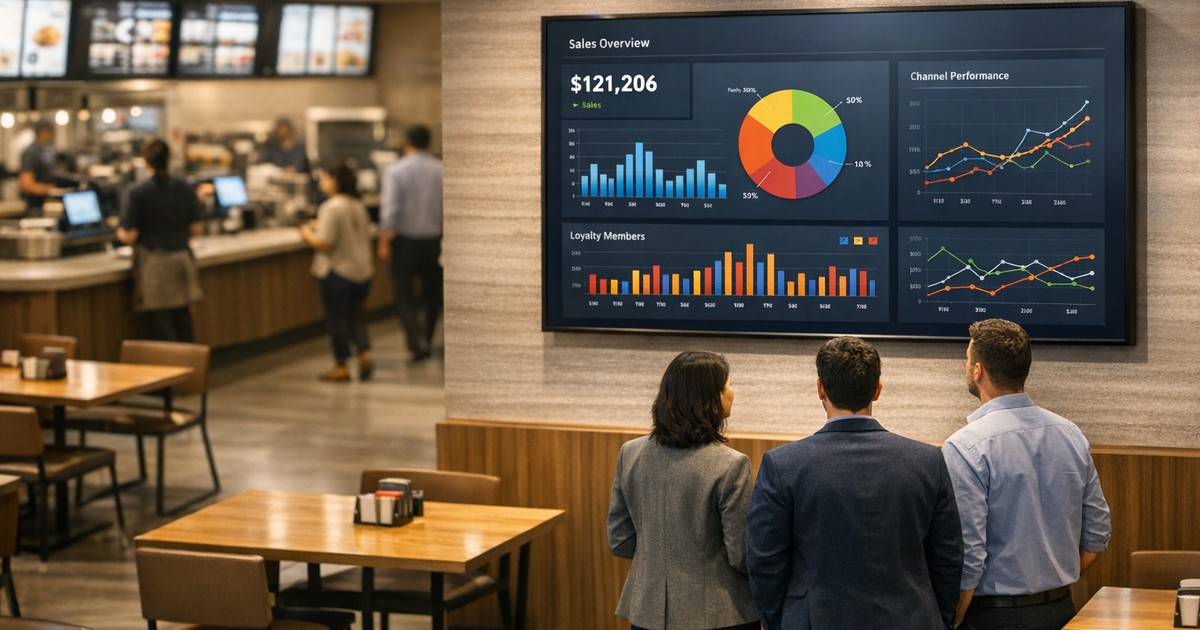
Walk into any enterprise QSR war room in 2026 and the conversation has shifted. The question is no longer whether to invest in kiosks, mobile ordering, or loyalty programs. All three are table stakes. The question keeping VPs of Technology and F&B Operations up at night is far more urgent: why can't these systems talk to each other?
More than one-third of QSR brands now cite fragmented systems as their single greatest barrier to delivering a better guest experience. The kiosk runs on one platform. The POS on another. Loyalty lives in a third silo. Menu updates require manual replication across each channel. And the data that should be driving smarter decisions sits locked in disconnected databases, invisible to the people who need it most.
This is the silo problem at scale, and in 2026 it has become the defining operational challenge for enterprise foodservice.
The financial toll of disconnected systems is no longer theoretical. Analyst estimates attribute 20 to 30 percent of revenue leakage in multi-location restaurant operations to fragmented technology stacks: lost revenue from inconsistent pricing, missed upsell opportunities, untracked loyalty redemptions, and menu errors that propagate silently across locations.
Consider what fragmentation looks like in daily operations. Without a centralized content management system, operators report spending more than 20 hours per week simply pushing menu updates, pricing changes, and promotional content across kiosks, POS terminals, and digital ordering channels. That is a half-time employee per location dedicated to data entry that a unified platform would automate.
The performance gap between locations tells an equally compelling story. PAR Technology's 2026 QSR Operational Index found a 6.4x performance gap between the highest- and lowest-performing QSR locations, a disparity driven in large part by differences in data connectivity and system integration. Locations where kiosk, POS, loyalty, and kitchen display data flow freely outperform those where it does not by a factor that should alarm any multi-unit operator.
For enterprise venues, including stadiums processing 40,000 transactions on game day, airports managing dozens of concessions across terminals, and casinos coordinating F&B across resort properties, the cost of fragmentation compounds with every additional location and channel.
Unified commerce is not a new buzzword, but the way the restaurant industry defines it has matured considerably in 2026. It is no longer sufficient to have integrations between systems. True unified commerce means a single operational layer where kiosks, POS, loyalty, kitchen display systems, payments, and reporting share the same data in real time. Not through batch syncs, not through middleware workarounds, but natively.
The industry is converging on this reality. PAR Technology launched PAR Intelligence in April 2026, an agentic AI operating system designed to connect data across POS, loyalty, ordering, and payments for multi-unit operators. NCR Voyix debuted Aloha Next, a cloud-to-edge unified commerce platform built on microservices with edge AI for offline resilience. Olo completed its acquisition of Spendgo to integrate loyalty directly into its ordering and payment suite, now serving tens of thousands of restaurant locations.
These moves confirm a clear industry signal: the platform era has arrived, and the winners will be operators who consolidate their technology stack around platforms that unify data at the transaction level, not just at the reporting level.
For enterprise operators running high-volume, multi-channel environments, the unified commerce framework must address five integration points simultaneously:
Any gap in this chain creates a silo. And every silo costs money.
Here is the insight that most unified commerce discussions miss: the kiosk is not just another ordering channel. It is the integration point where unified commerce either proves itself or falls apart.
The data makes the case. Digital kiosks are now the fastest-growing ordering channel in QSR, with 35 percent year-over-year growth according to the PAR 2026 QSR Operational Index. At the same time, 57 percent of restaurant brands now generate more than 25 percent of their sales through digital channels, up eight percentage points year-over-year. The kiosk sits at the intersection of in-venue digital commerce and physical operations in a way that no other channel does.
Unlike mobile ordering, which happens off-premise and before the guest arrives, the kiosk is an in-venue, real-time interaction. It must reflect the current menu. It must recognize the loyalty member standing in front of it. It must communicate the order to the kitchen display system instantly. It must process payment and apply promotions correctly. And it must do all of this while delivering the 15 to 30 percent average check increase that operators have come to expect from well-implemented kiosk programs.
This is why the kiosk is the acid test for unified commerce. If your kiosk cannot pull a loyalty profile, apply a personalized offer, send the order to the KDS, and settle payment, all through a single integration layer, then your "unified" commerce platform has a gap that guests will feel and your P&L will reflect.
For enterprise venues, the stakes are even higher. A stadium kiosk must handle surge ordering at halftime with zero latency. An airport concession kiosk must support multiple brands from a single device. A casino resort kiosk must integrate with property-wide loyalty programs that span gaming, dining, and entertainment. These are not edge cases. They are the operating reality for enterprise kiosk deployments.
When kiosk, POS, loyalty, and kitchen systems operate on a unified platform, the benefits cascade across the operation.
Revenue recovery. Eliminating the 20 to 30 percent revenue leakage from fragmented systems is the single largest financial opportunity. Consistent pricing, automated upsell logic, and accurate loyalty redemption tracking across every channel close the gaps where revenue disappears.
Loyalty acceleration. Loyalty transactions grew 28.5 percent year-over-year in the PAR 2026 QSR Operational Index, but that growth only translates to revenue when loyalty data is accessible at every touchpoint, including the kiosk. A kiosk that cannot identify a returning guest or apply their earned rewards is a missed conversion, repeated thousands of times per location per year.
Operational efficiency. Centralized menu and content management through a cloud CMS eliminates the 20-plus hours per week of manual update overhead. When a limited-time offer launches, it appears simultaneously on every kiosk, every POS screen, every digital menu board, and every mobile channel, with pricing, imagery, and availability rules intact.
Data-driven performance management. The 6.4x gap between top and bottom locations is not inevitable. When every transaction, across every channel, flows into a single data layer, operators gain the visibility to identify underperforming locations, diagnose root causes, and replicate the playbooks of their best-performing sites.
Speed to market. Enterprise operators adding new locations, launching new brands, or entering new venue types can deploy pre-configured kiosk and POS environments from a centralized platform, reducing launch timelines from months to weeks.
The competitive landscape in enterprise QSR technology is intensifying, and operators who delay their unified commerce strategy face a widening gap. The brands that have already consolidated their kiosk, POS, loyalty, and kitchen systems onto a single platform are capturing compounding advantages: richer guest data, faster operational iteration, and stronger unit economics.
As kiosk channel growth continues its trajectory, as loyalty programs become the primary growth engine for QSR brands, and as digital channels cross the threshold where they represent a quarter or more of total revenue for the majority of operators, the cost of maintaining fragmented systems will only escalate.
The operators who will lead in 2027 and beyond are the ones making the integration decision today, choosing platforms built from the ground up for multi-channel, multi-location, multi-brand complexity.
XPRPOS was built for this moment. Our platform delivers enterprise kiosk POS integration, loyalty, KDS, payments, and cloud-based menu management through a single, unified commerce layer, purpose-built for the complexity of stadiums, airports, casinos, QSR chains, and multi-brand venue operators.
If your organization is ready to eliminate the silos between kiosk, POS, and loyalty, and to capture the revenue, efficiency, and guest experience gains that unified commerce delivers, request a demo from XPRPOS today.
Stop managing workarounds. Start operating as one connected platform.
Ready when you are
Book a 30-minute demo. We’ll set it up with your menu, your brand colors, and the full ordering-to-kitchen flow on your POS — not a generic walkthrough.