
Operations
AI-Powered Workforce Rebalancing: How Self-Service Kiosks Are Freeing Staff for Revenue-Generating Roles
9 mins read
Operations
The headline every QSR operator dreads reads something like this: "Robots Replace Restaurant Workers." It makes for easy clicks. It also gets the story almost entirely wrong.
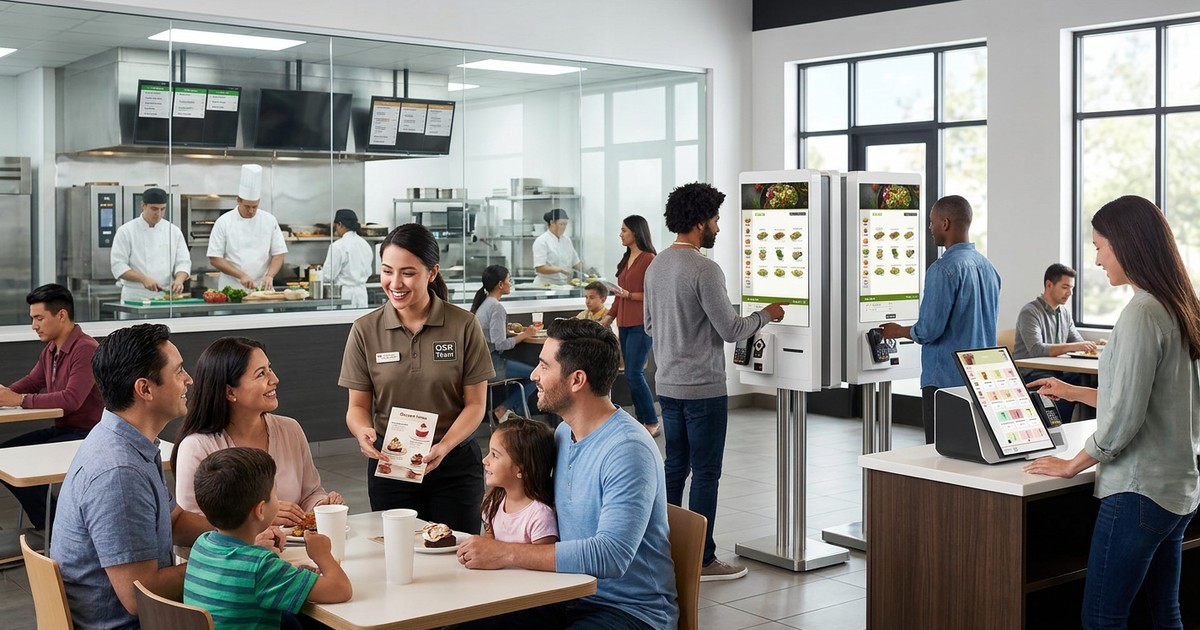
The real transformation happening across enterprise foodservice in 2026 has nothing to do with elimination and everything to do with redeployment. The operators pulling ahead are not using self-service kiosks to shrink their teams. They are using kiosks to redeploy their people from low-value, repetitive order-taking into roles that directly generate revenue, protect guest experience, and reduce costly errors. That shift — workforce rebalancing powered by self-service kiosks — is the operational playbook that separates margin leaders from everyone else.
Walk into any multi-unit QSR boardroom and you will hear two competing stories about labor. Story one says kiosks eliminate jobs. Story two says the labor shortage means there are not enough people to eliminate in the first place.
Both miss the point. The real opportunity is workforce rebalancing: taking the 60–70% of peak transactions that kiosks can absorb and using that freed capacity to fund roles your operation desperately needs but could never justify staffing before — dedicated table-touchers, expeditors, drive-thru flow managers, and quality-control leads.
Industry data confirms the direction. Digital and kiosk orders now represent well over half of total transactions at major chains, with forward-leaning brands pushing that figure past 60% during peak dayparts. That is not a footnote. It is a structural shift in where labor should be allocated.
When you evaluate kiosk vendors, this workforce rebalancing lens should be central to your criteria. A kiosk that only processes orders faster is a commodity. A kiosk platform that integrates with your labor model and gives you the data to redeploy freed staff toward revenue is a strategic asset. For a deeper look at what to demand from vendors, see the QSR CTO's Guide to Evaluating Kiosk Vendors.
Let us make this concrete with numbers that enterprise operators can validate against their own P&Ls.
Scenario: A 4-register QSR location during lunch peak (11:00 AM – 1:30 PM)
Those 2–3 FTEs are not a cost cut. They are an investment reallocation. Each person you move from a register to a guest-facing revenue role carries a labor cost you are already paying. The question is whether that cost generates $0 in incremental revenue (standing behind a register) or $50–$150 per shift in upsells, recovered service failures, and throughput gains (working the dining room, drive-thru, or expo line).
Multiply that across 200, 500, or 1,000 locations and the math changes the entire labor line of your income statement — without a single layoff.
Operators frequently cite the direct check-average increase that kiosks deliver through suggestive selling and visual merchandising. Industry-wide, that figure sits in the 15–30% range on kiosk orders, a meaningful gain on its own.
But the bigger prize lies in what happens with the people kiosks free up. Operators who systematically redeploy freed staff into three specific roles are reporting an additional 8–12% revenue lift on top of the kiosk's direct contribution:
1. Table-touching and guest engagement. A staff member dedicated to greeting guests, checking on satisfaction mid-meal, and offering dessert or beverage upsells generates incremental revenue that no kiosk screen can replicate. Human connection at the right moment — when a guest is already enjoying their meal — converts at significantly higher rates than a digital prompt at the point of order.
2. Expediting and throughput optimization. During peak, a dedicated expeditor keeping the make line organized and orders flowing accurately can reduce average ticket times by 15–20%. Faster throughput means more guests served per hour. More guests served means more revenue captured during the finite peak window.
3. Drive-thru flow management. For QSRs with drive-thru, deploying a freed FTE as an outdoor order-taker or line manager during peak cuts drive-thru times and reduces balking (guests who see a long line and leave). Even a 5% reduction in balking at a high-volume drive-thru translates to meaningful daily revenue recovery.
This layered approach — kiosk direct lift plus staff redeployment lift — is where the real ROI case for self-service kiosks labor rebalancing comes together. It also changes the payback timeline. Instead of justifying kiosks solely on labor savings or check-average increases, you can model a combined revenue and efficiency case that clears most CFO hurdles in under 12 months.
The most sophisticated operators are adding a third dimension to workforce rebalancing: AI-driven scheduling that dynamically matches staff allocation to real-time kiosk versus counter traffic patterns.
Here is what that looks like in practice. AI scheduling platforms analyze historical sales data, weather patterns, local events, and seasonal trends to predict optimal staffing levels — with accuracy rates that many vendors now report exceeding 90%. When integrated with kiosk transaction data, these platforms can answer questions like:
Operators leveraging AI-driven scheduling report labor cost improvements of 8–12% while simultaneously improving service quality through better allocation. The key insight is that workforce rebalancing is not a one-time staffing decision made during deployment. It is a continuous optimization loop that AI makes tractable at scale.
XPRPOS kiosk deployments feed real-time transaction and traffic data into your operational stack, giving AI scheduling tools the inputs they need to make these decisions location by location, daypart by daypart. For a view of how this data flows across a large multi-brand portfolio, see How XPR Fleet Manager Powers 100+ Brands.
Technology is the easy part. The hard part is getting your people to embrace new roles — and to excel in them.
Operators who treat kiosk deployment as a pure technology rollout and ignore the human side consistently underperform on the rebalancing opportunity. Here is a change management framework that works across multi-unit QSR and enterprise foodservice:
Communicate the "why" before the "what." Staff who hear "we are installing kiosks" without context will assume the worst. Lead with the message: "We are investing in technology that handles routine order-taking so you can move into roles that are more engaging, more valuable to guests, and more rewarding for you."
Create new role definitions with clear KPIs. "Guest engagement lead" is meaningless without measurable expectations. Define what success looks like: number of table touches per shift, upsell conversion rate, average guest satisfaction scores. Make these roles feel like promotions, not lateral moves.
Tie compensation to the new roles. If freed staff are expected to upsell, let them share in the upside. Even a modest incentive — $1 per dessert upsell, a shift bonus for hitting a throughput target — signals that the organization values the new work.
Cross-train aggressively. The most resilient staffing model post-kiosk is one where every team member can flex between kiosk assistance, guest engagement, expo, and traditional counter service as traffic patterns shift. Cross-training also protects you during callouts and unexpected volume spikes.
Use kiosk data to coach, not just schedule. Platforms like the XPR Discovery Feed surface real-time data on ordering patterns and guest behavior. That data can inform staff coaching: which upsells are converting on the kiosk, which are not, and where human intervention in the dining room can close the gap.
This is the mistake that destroys the entire business case, and it happens more often than anyone in the industry wants to admit.
The pattern is predictable: kiosks go live, peak-hour order-taking becomes more efficient, and a well-meaning finance team sees an opportunity to cut shifts. Within 60 days, guest satisfaction scores start sliding. Kitchen ticket times spike because kiosks are actually increasing order volume (they are faster than humans and never close a register), but no one added kitchen capacity to match. The dining room feels neglected. Drive-thru times creep back up because the outdoor order-taker was cut.
The result is a kiosk deployment that looks great on the labor-cost line but bleeds revenue everywhere else.
The antidote is discipline. Workforce rebalancing only works when operators commit to redeploying freed capacity rather than eliminating it. The goal is not fewer labor hours — it is better-allocated labor hours.
Monitoring is essential. Track guest satisfaction, throughput, and kitchen ticket times alongside labor cost per transaction. If satisfaction drops while labor costs fall, you have cut too deep. Kiosk uptime is another critical variable here — when a kiosk goes down during peak and you have already pulled register staff, the guest experience collapses immediately. For a full breakdown of this risk, read The Hidden Cost of Kiosk Downtime.
Build a staffing floor into your labor model: a minimum FTE count per shift that holds regardless of kiosk adoption rates. That floor should account for kitchen throughput, guest engagement coverage, and a buffer for kiosk-assist needs (not every guest is comfortable with self-service, and forcing the issue damages your brand).
Self-service kiosks in 2026 are table stakes for any serious QSR or enterprise foodservice operator. But the technology alone is not the differentiator. The operators who win are the ones who pair kiosk deployment with a disciplined workforce rebalancing strategy — redeploying people into roles that drive revenue, protect guest experience, and make the entire operation more resilient.
That requires the right kiosk platform, the right data infrastructure, and the right operational framework to tie them together.
XPRPOS kiosk deployments are built for exactly this model. Every deployment includes workforce rebalancing guidance tailored to your format, daypart mix, and labor market. From real-time transaction data that feeds your AI scheduling tools to fleet-wide visibility across hundreds of locations, XPRPOS gives enterprise operators the foundation to turn self-service into a genuine labor strategy — not just a cost play.
Request a workforce rebalancing consultation with the XPRPOS team and see how your kiosk deployment can unlock the full revenue potential of your existing team.
Ready when you are
Book a 30-minute demo. We’ll set it up with your menu, your brand colors, and the full ordering-to-kitchen flow on your POS — not a generic walkthrough.