
Industry Events
XPR at FS/TEC 2026: Voice and Touch Self-Ordering Built for the Year Restaurants Asked for Proof
7 min read
Industry Events
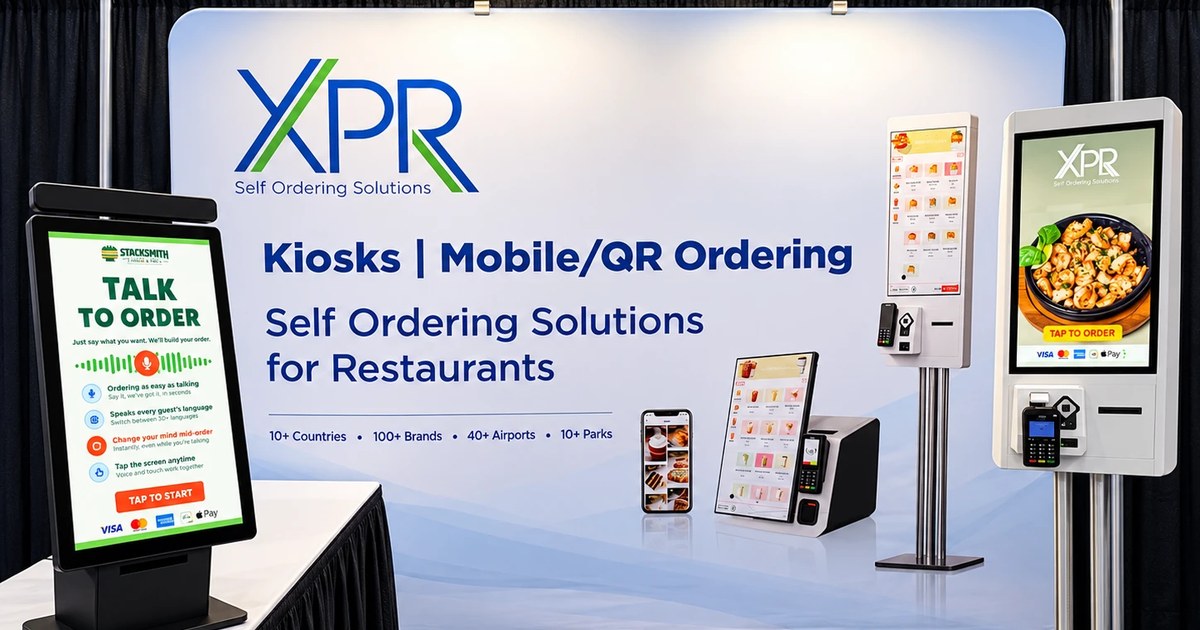
FS/TEC celebrated its 30th year this September, and XPR was there. From September 23 to 25, restaurant technology leaders filled the Gaylord Texan Resort & Convention Center in Grapevine, Texas, and our team spent three days at Booth #432 running live menus on our kiosks and talking with operators from quick service chains, airports, stadiums, parks, and hotels.
The mood on the floor this year was practical. Operators came with sharper questions about cost, return, and reliability, and less patience for technology that cannot prove its value. That suited us well, because everything we brought to Grapevine was built around one idea: self-ordering that pays for itself and keeps working on the busiest day of the year.
Here is what we showed, and why it matters for anyone planning a self-ordering investment in 2027.
A few themes came up in nearly every session and conversation:
Each of those themes maps directly to something we demonstrated at Booth #432.
The kiosk at the front of our booth drew the most conversation all week. XPR Talk to Order lets guests simply say what they want and watch the order build on screen in real time.
That last point is what turns AI capability into an AI outcome. Voice ordering only moves the numbers when guests actually use it, and guests use what feels natural to them. With Talk to Order, the guest decides. The guest who wants to talk gets speed. The guest who would rather tap gets a familiar screen. The guest who starts with voice and finishes with touch gets both. Every order lands in the POS the same way, with modifiers and combos intact.
Operators who stopped by asked the practical questions: how it handles a noisy dining room, complex modifiers, and menu changes. We cover those in depth in how AI voice ordering at the kiosk changes the speed-of-service equation.
This is what an AI outcome looks like on a P&L. In a year when every investment has to justify itself, we led with results, not features. Across XPR deployments, kiosks deliver a 20%+ average check lift, driven by visual menus, smart upsell and cross-sell prompts, and guests who take their time without a line pressing behind them.
That lift, combined with labor that can shift from order-taking to hospitality and food production, is what turns a kiosk from a cost line into a revenue line. If you are building the business case after the show, our 90-day kiosk pilot playbook walks through how to set go/no-go metrics before you sign anything.
The integration lesson from this year's show was hard to miss: every extra hop between an ordering channel and the POS is another place for an order to disappear.
XPR integrates directly with the POS systems enterprise operators already run, including Oracle Simphony, PAR POS, Genius POS, and Square, along with payment gateways and loyalty platforms. There is no middleware layer to fail, no third-party connector to troubleshoot, and no menu drift between the kiosk and the counter. Menu and pricing changes made once flow to every kiosk, and kiosk orders reach the kitchen formatted exactly like counter orders.
For the bigger picture on why this matters, read The Unified Commerce Imperative.
For airport, stadium, and park operators, the first question at our booth was often: what happens when the network goes down?
XPR kiosks keep taking orders. Menus and reporting live in the cloud, but ordering runs locally on the device with store-and-forward payments, so a connectivity outage does not turn your kiosks into very expensive screens during a rush. We explain the architecture in Offline-First: Why Your Kiosk Must Process Orders Without the Internet.
Multi-unit operators wanted to know how they would manage hundreds of kiosks without adding headcount. XPR Fleet Manager shows device health, software versions, remote restarts, and updates for every kiosk in every store from a single screen. Problems get spotted and fixed remotely, often before a store manager notices.
Not every operator wants to be locked into one hardware vendor. XPR runs on Windows or Android, in countertop, floor-standing, or wall-mounted form factors, and fits enterprise MDM and security policies. Our booth showed that range: a countertop Talk to Order unit alongside a floor-standing kiosk with an integrated payment terminal and receipt printer.
The question that closed many booth conversations was simple: who else runs this at scale?
XPR powers self-ordering for some of the busiest airport terminals, stadiums, and parks in the world, as well as quick service and fast casual locations from major global brands. Across QSR and fast casual, airports, stadiums, parks, casinos, hotels and resorts, and business dining, that adds up to 100+ brands, 10+ countries, and 40+ airports, with multi-brand, multi-language, peak traffic every day.
FS/TEC 2026 made one thing clear: the bar for restaurant technology is higher than ever. Operators want proof of return, guests want a choice in how they order, and nobody wants an integration that drops orders or a kiosk that goes dark when the network does.
That is exactly the standard XPR is built to meet: voice and touch ordering that guests actually choose to use, a proven check lift, direct POS integration with no middleware, offline resilience, and fleet-wide control from one dashboard.
Thank you to everyone who stopped by Booth #432, and congratulations to FS/TEC on 30 years. If we did not get a chance to meet in Grapevine, or you want to see your own menu running on an XPR kiosk, schedule a demo with our team. We look forward to seeing you at FS/TEC 2027, September 15 to 17, back at the Gaylord Texan.
Ready when you are
Book a 30-minute demo. We’ll set it up with your menu, your brand colors, and the full ordering-to-kitchen flow on your POS — not a generic walkthrough.